Loading...
AC
Loading...
Loading...
Agentic AI
Corporate websites are evolving from collections of pages into intelligent interfaces that can interpret intent, retrieve trusted information and initiate governed workflows. America.gov demonstrates the direction of travel, while also showing why secure integrations, authoritative content and human oversight matter as much as the conversational interface.
Loading...
If you are assessing whether your website, knowledge base and operational systems could support this type of experience, discuss your situation with Agent Crew and identify where an agentic interface would deliver practical value.
Book a demoMost corporate websites still reflect how the organisation is structured internally. Products sit in one section, support content in another, forms live inside separate portals, and important information is scattered across PDFs, knowledge bases and business systems.
Visitors are expected to understand that structure, choose the correct navigation path and translate their needs into the organisation's terminology. Adding a search bar or general-purpose chatbot improves the surface, but it does not solve the underlying fragmentation.
By 2027, the more useful corporate websites will begin operating differently. They will function as intelligent service interfaces that interpret intent, retrieve information from approved sources, coordinate workflows and help users complete tasks through one coherent conversation.
This does not mean every website will become an autonomous AI agent. It means the strongest digital experiences will combine conversational AI with governed access to the organisation's existing content, data and processes.
The launch of America.gov on 29 September 2026 provides a large-scale example of this direction. According to the official GSA announcement, the platform combines information from more than 29,000 US government websites with AI-enhanced search tools, creating a single entry point for government information and services.
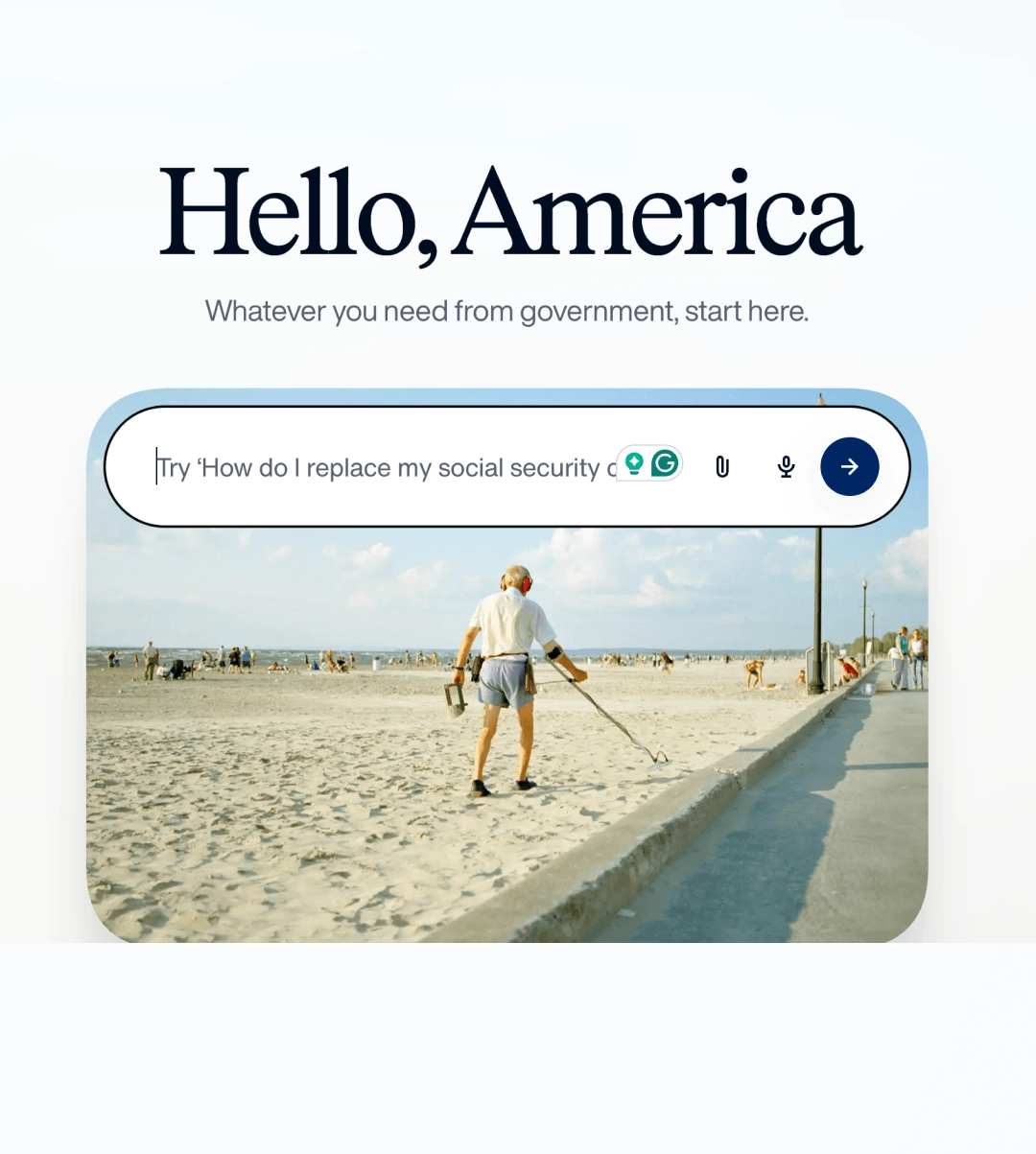
It is more accurate to describe this as a unified interface over fragmented sources than as the literal replacement of 29,000 websites. The underlying agencies, records and systems still exist. America.gov helps users find and understand their information without first knowing which agency or website is responsible.
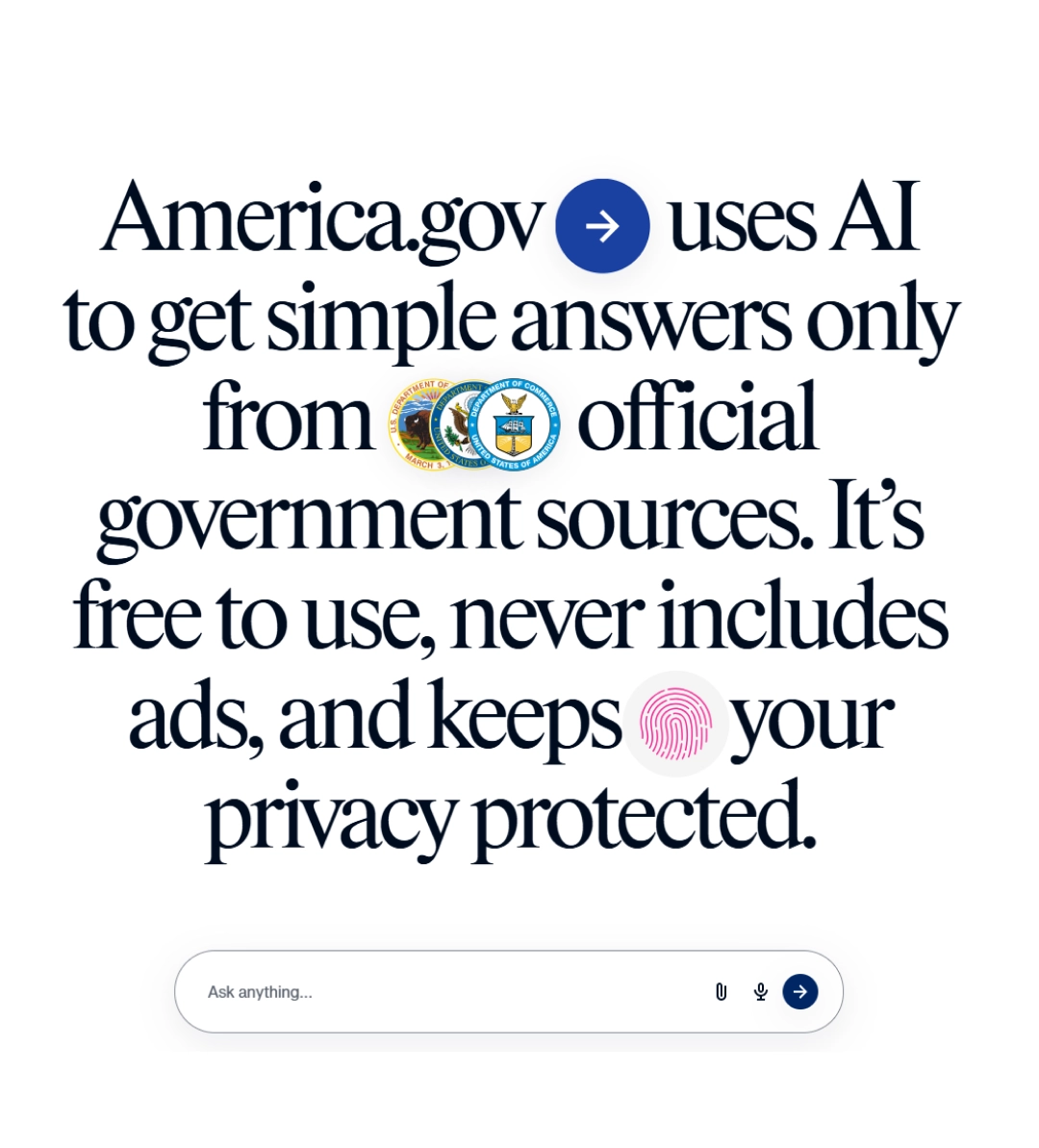
The distinction matters. The opportunity for businesses is not necessarily to rebuild every system or consolidate all data into one enormous database. It is to create an intelligent access layer that can work across existing systems while preserving appropriate ownership, permissions and controls.
America.gov also illustrates the gap between answering and acting. Its current FAQ states that the service cannot yet access agency records or check an application's status. The associated executive order describes a broader ambition for authenticated transactions where they are authorised and technically available.
That progression, from finding information to completing work, is the central story of agentic websites.
A conventional website presents pages. A search function returns links. A basic chatbot retrieves passages and turns them into an answer.
An agentic website goes further by determining what the user is trying to achieve and coordinating the appropriate next steps. Depending on the organisation and the user's permissions, it may:
Consider a professional services firm. A prospective client might currently move between service pages, staff profiles, downloadable guides and a generic contact form. An intelligent interface could clarify the client's situation, present relevant service information, collect initial requirements and route the enquiry to the appropriate practice area.
The agent should not decide whether the firm accepts the engagement or provide unreviewed professional advice. Those decisions can remain with qualified people. Its value comes from removing unnecessary navigation and administrative repetition.
The visible conversation is only the front end. Most of the work required to make an agentic website dependable happens behind the scenes.
The system needs to know which sources it can use, how current they are and which source takes precedence when information conflicts. Marketing pages, support articles, policy documents and operational databases should not automatically be treated as equally authoritative.
Content ownership therefore becomes part of AI governance. If nobody is responsible for updating a policy or product record, the conversational interface may confidently surface outdated information.
The orchestration layer determines what happens after a user makes a request. Some steps may use AI reasoning, such as classifying an unusual enquiry or extracting meaning from an open-ended description. Other steps should remain deterministic, meaning they follow explicit business rules.
For example, AI may interpret that a customer wants to change a booking. A rules-based workflow should then verify identity, check the booking system and enforce cancellation policies. This combination is generally safer than allowing a language model to improvise the entire process.
Agent Crew's workflow automation and AI agent services focus on this connection between the conversational experience and the operational systems that must complete the work.
An agentic interface is only as useful as the access it is given, but broader access also creates greater risk. Reading public support content is different from viewing a customer's account, changing a reservation or submitting a financial application.
Authentication, role-based permissions, data minimisation and audit logs need to be designed around each action. Sensitive operations may require explicit confirmation or human approval before execution.
Production systems need observable failure paths. The organisation should be able to see which sources were used, which tools were called, whether an action succeeded and why a request was escalated.
A well-designed agent should also recognise when it lacks sufficient information or authority. Handing a structured case to a person is often the correct result, not a failure of automation.
Many organisations will attempt this shift by adding a conversational widget to their existing website. That can be useful for narrow information retrieval, but it does not automatically create an agentic experience.
If the assistant cannot access current information, identify the user or interact safely with operational systems, it becomes another navigation tool. It may reduce search effort, but the customer still has to leave the conversation, locate a form, repeat information and wait for a team to interpret the request.
The stronger approach starts with the service journey rather than the chatbot. Which user intentions create the most friction? Which systems contain the required information? Which decisions can be automated safely? Where must accountability stay with a person?
This is also why content strategy, automation and AI answer engine optimisation are becoming connected disciplines. Content must be understandable to people, discoverable by search engines and structured well enough for AI systems to retrieve and cite accurately. More analysis of these intersecting issues is available on our blog.
Several elements of the agentic website model are already practical when the scope is controlled. These include grounded answers from approved sources, enquiry classification, lead qualification, appointment requests, document intake, support triage and workflow initiation through existing integrations.
More sensitive uses require additional controls. Account-specific recommendations, regulated advice, consequential eligibility decisions and transactions involving personal or financial data should not be treated as ordinary chatbot features.
Reliability depends less on how human the conversation sounds and more on whether the system can:
Teams also need to understand where the system's responsibilities end. Practical AI training and capability development can help staff supervise automated workflows, identify poor outputs and improve the underlying processes without assuming the AI is infallible.
The year 2027 is not a guaranteed deadline after which conventional websites disappear. It is a practical planning horizon for organisations making website, customer portal and automation investments now.
Website redesigns often involve long procurement and implementation cycles. A business commissioning a new digital platform should therefore consider whether the architecture can support conversational discovery, governed retrieval and workflow integration, even if those capabilities are introduced gradually.
The risk is not simply having an old-looking website. It is investing in another isolated presentation layer that cannot communicate with the systems where customer work actually happens.
Business leaders such as CEOs, CMOs and CIOs evaluating their next website or portal should ask:
The next generation of corporate websites will not be defined by a larger language model or a more animated chat window. Their advantage will come from connecting fragmented knowledge and operational workflows through an interface that is easier for customers to use and safer for the organisation to govern.
America.gov is an early, high-profile signal of this change. It demonstrates the value of placing a conversational layer over thousands of distributed sources, while its current limitations show why information retrieval is only the first stage.
For businesses, the goal should not be to make every interaction autonomous. It should be to create a coherent digital front door that resolves routine needs efficiently, protects sensitive processes and brings people into the loop when judgement or accountability is required.
If you are assessing whether your website, knowledge base and operational systems could support this type of experience, discuss your situation with Agent Crew and identify where an agentic interface would deliver practical value.